Showing posts with label expatlife. Show all posts

Sunday, October 21, 2012

Apologies! Life got in the way...

So this is something of a travel smörgåsbord post; thinly disguised as an apology for having shirked my writing responsibilities for so long. You see, lately I've been way too busy living life to find time to write about it. I've drafted dozens of posts in my head while traipsing through the summer and early fall. But now sitting before an intimidating blank screen prepared to illustrate them in full-color glory, I hardly know where to begin!

At the start of summer I took off for Munich, and wrote a review of that Summer trip slated "First up: Munich" but then failed to ever report on subsequent forays. So here's a belated recap of some other summer adventures, with a couple teasers for travel posts still to come...

Switzerland
In late July, we visited Lucerne, Switzerland with my brother and his family. I wish I had been able to capture better photos, but the weather most of the time was miserably cold and rainy. What I do need to share is that we took an awesome (albeit freezing cold and wet) excursion that, one day, I'd like to repeat under fairer skies and which I strongly encourage you to take if you find yourself visiting the Swiss Alps. It was the Golden Round Trip to Mt. Pilatus. This tour involved a ferry ride across the incredibly beautiful, turquoise-blue Lake Lucerne, followed by a slightly scary spectacular ride up the world's steepest cog railway. Once atop the nearly 7,000 foot peak, you have the opportunity for some awesome hiking and sightseeing. Unfortunately, we couldn't see much, entombed as we were in formidable rain clouds. To descend the summit, the tour includes an aerial cableway ride part-way down, then you switch to smaller gondolas for the remaining trip to the foot of the mountain at Fräkmüntegg. A short bus ride then returns you to the starting point in Lucerne.

Another day trip in Alpineland included a boat ride to Europe's largest waterfall: Rhine Falls and a hike through the town of Schaffhausen. This was nice, but if you've been to Niagara Falls, Yosemite Falls, or Viktoria Falls (among many other gorgeous river cascades) prepare to be unimpressed.

One of the more exciting adventures for the men in our group was a day of Canyoning in Interlaken. Unfortunately, since the younger kids were too small for this, my soon-to-be sister-in-law and I got stuck taking the four little ones to a noisy, chlorine-filled indoor water-park. The kids loved it, we couldn't wait to get back to the hotel and crack open a bottle of red!

Bavaria
We departed Switzerland after a few days and headed for the fairy-tale Neuschwanstein Castle. At least on this day, the weather gods blessed us so we were able to enjoy stunning views in the German Alps. Arriving too late to get tour tickets for the famous structure that inspired Disney's Cinderella Castle, we were able to tour the neighboring Hohenschwangau Castle, where King Ludwig II spent his summers growing up and actually lived while building his dreamy princess palace. The tour was fantastic and I was really glad we did it. The rooms of the castle are richly furnished and the wall murals are amazing. We were able to get a sense of what life was like in the castle during the early to mid 1800s.

The castle visit was followed by another trip to Munich so my brother and family could visit my daughters and experience a traditional German beer garden, among the other great sights of this historic city. Most of this rainy trip included the same points of interest I reported in the Munich blog post, minus the sunshine.

The Maldives
The final trip of our summer was a three-week dream vacation to a tiny atoll in the middle of the Indian Ocean - part of the Maldive Islands. That trip, which was a gift from my in-laws, is going to need its own blog post, so I promise to get one up in the next couple of weeks! Right now, I'm still sorting through the thousand photos we took and trying to assemble an album to give them as a thank-you present.

Autumn Adventures
Then summer ended, I celebrated my birthday, and the first full year of my new life in Germany came to a sentimental close. School resumed and life moved on at a somewhat normal pace, with the expected highs and lows of kids continuing to adjust to a challenging situation. We were all grateful when fall break arrived. And with it, came a visit from the American grandparents. That, too, deserves its own post. So as soon as I gather all the photos from the various trips we took to the Baltic, to Belgium, along the Rhine, and throughout the Ruhr region, I'll get them up for you!

Essen-Kettwig
And as a side note on crazy adventures, last week, in the middle of the fall break, with the grandparents and rest of the family as witnesses, my girlfriends and I participated in the Essen-Kettwig Drachenboot Race. This was a huge amount of fun and definitely worthy of its own blog post, but since my co-conspirators KettwigeFrau  and Expat Emma already blogged about it, I'll refer you to their wonderful sites! (And they're religious about updating their blogs, so check in often and you might even learn more about what I've been up to).

So, apologies again for not writing in so long. One of these days I'm sure life will slow down enough for me to find no other excuse for blog-procrastination! Until then, I hope you all are enjoying adventures of your own!

Thursday, June 7, 2012

A Few More Things to Know About Germans

Building on the incredibly accurate and witty list What I Know About Germans compiled by Liv of A Big Life and recently published by Überlin, here are some more things you should know about Germans… A to Z. (I tried not to duplicate, so be sure to check out the original list!)

A. They have an apprenticeship program for everything. Don’t think they got that super-efficient supermarket checkout system mastered by hiring high school students for part-time jobs, no those are highly trained “Auszubildene” supermarket checkout professionals. Pretty much every service and retail job is a trained profession requiring a 3-year apprenticeship.

B. They keep beautiful, perfectly manicured lawns (gardens) despite the fact that anytime one is off work and thus has free time to mow and weed the lawn, it is a crime to do so because…

C. Sundays are holy days of obligatory lounging and recreation and…

D. Saturday early mornings, mid-afternoons, and late evenings are equally off-limits for any work, particularly which might cause a sound or smell that could potentially disturb a sensitive neighbor.

E. Speaking of neighbors, Germans strongly endorse the phrase "fences make good neighbors" and have very strict laws on the placement and maintenance of fences, which surround every perfectly manicured lawn/garden in Germany.

F. Windows should be open almost all the time. Upon entering a classroom or office, or as soon as one awakes at home, if windows are not already opened, Germans must thrust them open and declare the need for "Luftung." Even if it's below freezing and, as usual, raining.


G. During required Sunday quiet-time recreation, everyone must go for a walk. No matter the rain, Sunday afternoon is time for a "Spaziergang." Bike rides are an acceptable alternative, but....

H. Germans never bike on a a designated walking path. Doing so will get you a fine, which can actually count against your driver's license if you have one. Bikes may be ridden on bike paths or the street, and....

I. ...only if said bike is properly equipped with working lights and a bell. There will be an inspection, a test, and all other matter of formal paperwork processing to ensure that every bike in Germany meets all safety standards.

J. Given that it rains 80% of the year, they are amazingly adept at scheduling lawn maintenance and other chores around both inclement weather and obligatory quiet times. This goes back to their perfect planning and preparedness skills.

K. Like banks, pharmacies and doctors' offices are closed mid-days for lunch, Wednesday afternoons, and, of course, on weekends. So make sure you only get sick or allow your children to develop a fever during standard work-hours.

L. And if you or your child does get a cold or sprain an ankle, expect to be excused for at least a week from work or school. Illness or injury of any degree is taken quite seriously and requires one be “Krankgeschrieben” from work and/or school for an appropriate period of recovery. (Probably because it took a week to find an available doctor or pharmacy).

M. Germans love sun-soaked vacations (of course, the weather in Germany is dismal!). They flock to amazing beach resorts every year in a mass exodus during the Autumn and Spring breaks, at which times there's a greater population of German tourists in Mallorca, Ibiza, the Maldives, Grand Cayman, Antalya, Crete, Hurghada, etc, than any other nationality or the native inhabitants.

N. Like their lawns, their cars are also cleaned and polished to sparkling, despite the constant rain and required work-free timezones. It’s a federal crime to drive a dirty car. (I’m pretty sure)

O. OK, really, everything is always clean and polished. The garden, the car, the house, the boots. Germans have a penchant for cleanliness – I believe they place it not next to, but above godliness.

P. Germans are pretty trusting. I suspect they believe everyone plays by the same rules of fairness to which they subscribe. It's not uncommon to order products, books, etc. and have them delivered to you before payment, with a bill sent separately. They never seem to worry that one might fail to pay the invoice.

Q. Cash is king in Germany. They may not worry about you paying the bill, but they do worry you might overextend yourself on credit. Very few places accept credit cards. Cash and debit cards MAYBE, but even these are not accepted at a great many places. Be prepared to pay even for the delivery of your new washing machine and refrigerator in cash -even if that's up to a 1,000 Euros.

R. Oh that refrigerator. It does not come with the house. Nor does the kitchen sink, cabinets, or counters. Kitchens being a matter of personal preference, expect to find nothing more than an empty room with a pipe sticking out of the wall for water hook-up in your new apartment or house. Kitchen sold separately.

S. Light fixtures, too. Germans take everything not made of brick and mortar out of the house when they move. So bring your own ceiling lamps or the switch on the wall is worthless.

T. German employers request a lot of personal information. As well as your actual birth date, you must include a photo and your marital status on your resume. Do NOT smile in your resume picture. Smiling makes you very suspect.

U. German elementary schools are only a half day. Before fifth grade, it's rare for kids to be in school past 13:00 and more common for them to be home before noon. The recent introduction of "Ganztagsschule" or all-day school, basically provides after-school homework help but not full day instruction. But that's OK, because the super efficient German teachers can easily convey everything the super smart German children need to know in half the time other countries need to educate their young-uns.

V. Germans are dedicated to their sports teams. In fact, public viewing of National Soccer tournaments is one of the only occasions when all noise, smell, and light-restricting ordinances are lifted, and revelers may party in public as long and loudly as they wish to support the home team.

Germany Fans cheer the U19 Women's LAX World Championship
W. Germans are meticulous about recycling (dedicated to the preservation of the environment). There's an appropriate bin for every type of waste. Plastics and tin in one. Biodegradable food or yard waste in another. Glass, paper, etc. the "trash" bin is the smallest by far and to be used only for items that can't possibly be sorted into one of the other five waste baskets you have in the kitchen pantry. Expect to be fined if the trash collectors find the wrong refuse in the wrong bin.

X. Until you are a friend you are a “Bekannte” maybe even a “Gute Bekannte” but that translates to (close) acquaintance and should not be confused with a friend.

Y. They chose their friends very carefully. Do not presume to be friends with someone you’ve only met a few times, no matter how friendly the interactions were (This only makes you a Bekannte). It takes time to build a true friendship, but then you’ve got it for life.....

Z. Because of their dedication, trustworthiness, reliability, preparedness, value for recreation, regard for fairness, etc... (see points A through Y): Germans make awesome friends!

Dedicated to my amazing German friends :)

Monday, June 4, 2012

Multicultural Celebrations: The Brits are Fun!

Joining an expat community here in Germany has led to lots of interesting new experiences. Many of my "local" friends are actually British - not what I expected when I moved to Germany, but it's been a whole cultural experience of itself. The Brits are much more fun than this American ever gave them credit for.

I'm learning a whole new English language (who knew "crackers" were little packages that snapped and not something you eat with wine and cheese? And don't even get me started on the misunderstanding about what a "Pantomime" is!). These are some of the things I've learned during the group's monthly Native English Speaker Quiz night. I'm apparently not as native a speaker as I thought, since I can hardly understand half the things my British friends say. Forget the Aussies, South Africans, Scots, Singaporeans, and others who share some form of The Queen's tongue...

Thanks to the Brits, I've also had the chance to try new culinary treats (marmite, anyone?) and this weekend, I indulged for the first time in a cocktail I'd never heard of, that apparently is a big hit with folks on that little island across the North Sea: Pimm's Cup. I wish I could tell you exactly what Pimm's is, but as the bottle says, only six people know the secret recipe! Evidently, it's a gin-based, herb-spiked, 50-proof alcohol that is typically blended with Ginger Ale, cucumber, strawberries and mint to make a long drink. Mysterious, but very tasty.

I've had two recent opportunities to try this new concoction. The first was a slightly bawdy Eurovision party hosted by my friend, Emma. As with the cocktail, I'd never heard of the song contest when I was living in the the land of Stars & Stripes. (OK, I didn't have a TV and wasn't even familiar with American Idol, so all's fair). The guests at the Eurovision fete were all asked to represent a participating country and come in costume (or at least national colors) and bring an international dish to share. Representing Azerbaijan, I had a tough time coming up with a recipe I could prepare from local ingredients, but I did manage to create something that had a hint of Mediterranean flavor. In another post, I'll share my Caspian Chicken Kabobs and Baklava. The party was lots of fun, with most of us gathered around the TV, sampling from the amazing  smörgåsbord (wish I had photos, but major fail on this one) and cheering our favorite contestants. I do think Germany was totally cheated. Roman Lob is pretty hot. And he can sing. Just saying :) Still, the party was great fun, and I'm grateful to the UK gal pal who hosted and all those who brought yummy munchies and taught me about the Russian Grannies.

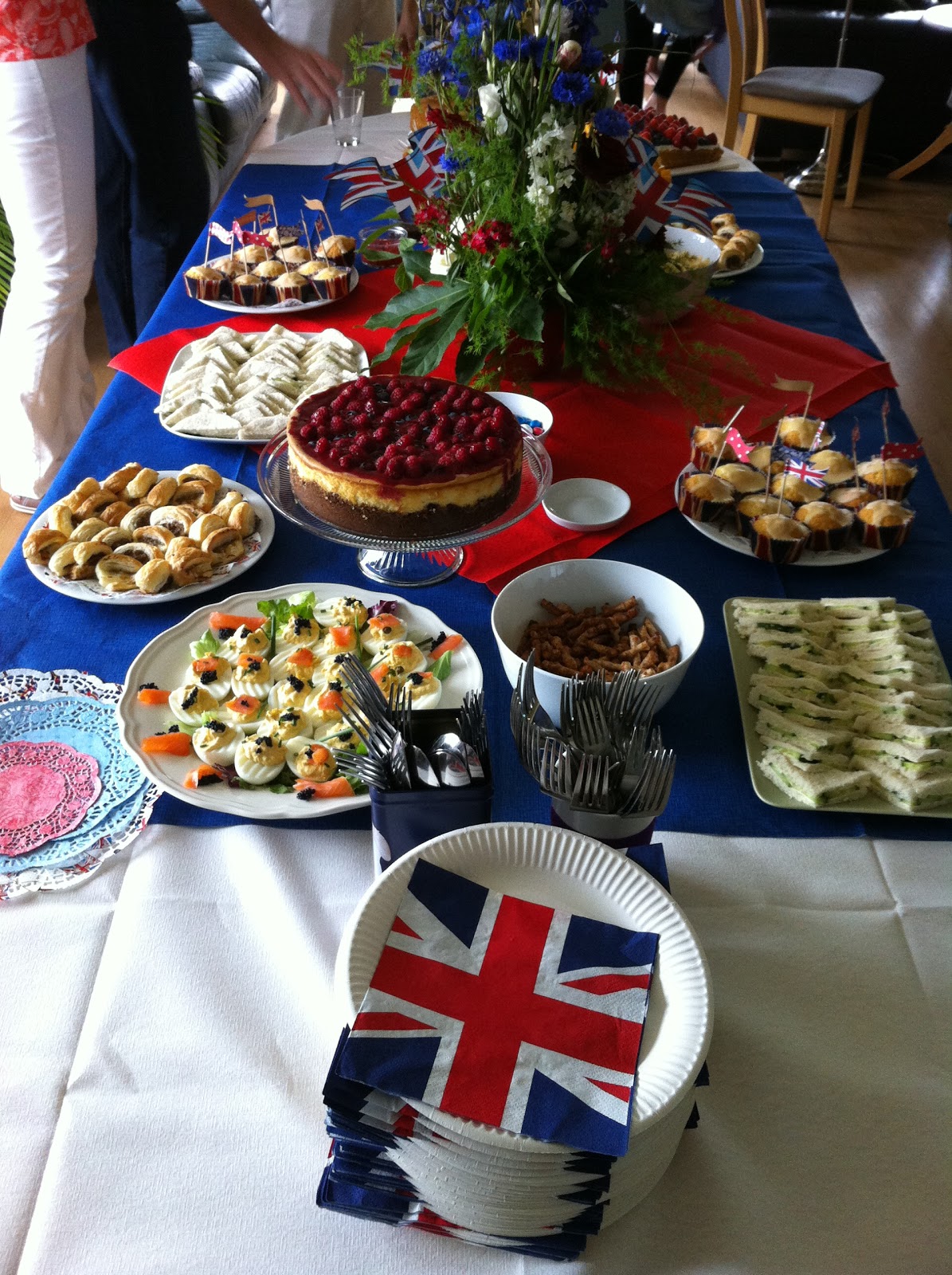
My next Pimm's party was a royal celebration of yesterday's Diamond Jubilee for Queen Elizabeth. The lovely Verena held an all British Bash at her place, which she had decked out to the 9's in red-white-and-blue swag. Seriously, the entire house was draped in bunting and balloons! It was suppose to be a garden party, but the Queen couldn't just let it rain on her parade - she sent the storms through North-Rhine Westphalia to demonstrate the extent of her reign ;) Nonetheless, we had a wonderful time, providing our own sunshine and lots and lots of CAKE. I've never seen so much cake outside of a bakery. There were cupcakes, and carrot cake, and apple cake, and lemon cake, and strawberry cake, and my white chocolate cheesecake (I'll post that one day, too) and a few others I'm not even sure of. Thank God I'm not diabetic!

And thankfully, there were some nom nom savory items as well to counter the sugar coma. We enjoyed traditional English sausage rolls, dainty cucumber and other tea-type sandwiches, and deviled eggs with lox & caviar.
As with the Eurovision event, we gathered at times around the telly to pity the poor drenched and cold but fine-looking Royal Navy boys and admire the incredible grace of The Queen. Despite the miserable conditions of the day, the Brits home and abroad sure know how to celebrate.

Really, I think the best thing about living in Germany might just be my very fun British friends! Who knew?

Friday, May 11, 2012

Kitchens, closets, and light fixtures: German housing deficits

My Ikea Kitchen in About 100 Boxes
As if being homeless through August wasn't enough, I spent the first several weeks "camping" in my new home in Germany. Even today, I still feel woefully under-equipped. You see, the lovely house I'm renting in Germany didn't come with some of the most basic provisions of modern-day housing. No kitchen. No closets. No light fixtures.

Where to Hang the Clothes?
We knew that houses in Germany would not have the convenient built-in (and often walk-in) closets we were spoiled with in the US. We are actually very lucky to have a small closet in one of the bedrooms. But for the most part, the storage of clothing in German bedrooms requires the purchase of hanging wardrobes ("Kleiderschränke"). We've acquired a couple moderate sized ones from Ikea for the kids' rooms, but the larger size and solid-wood style I want for my own room is going to require more of a budget than I have saved so far. Hence, most of my clothes are stuffed into dressers or in boxes and bins along the wall and under the bed. I feel a bit like I'm still living out of a suitcase.

Let There Be Light!
No Light Fixtures
It's a good thing that I'm a candle addict and typically have a dozen or so lit most evenings, anyway. Because one of the surprises here was that none of the rooms had lights! Apparently, light fixtures are considered a matter of personal taste, and therefore treated like any other furnishing. The previous tenants had unmounted, unscrewed, and otherwise removed every light fixture from every ceiling in the house - and this is considered perfectly normal and ok. Since we came from the United States, we did not bring any lamps with us, because 1) light fixtures are deemed built-in parts of the real-estate and required to stay installed in the house; and 2) the electrical system is completely different, so our lights would not have been any use to us in Europe anyway.

So far, we've purchased a few inexpensive standing floor and table-top lamps (thanks, again, Ikea). But we have yet to decide on most of the ceiling lamps we'd like. Thus, if you try the light switch in any given room, it probably won't work, and if you look up, you'll only see dangling wires.

Everything, *Including* the Kitchen Sink?!
The kitchen was an empty room, with water hook-up and some wall tiles
Ever hear the term "they took everything except the kitchen sink?" Yeah, well, here, they took that, too! And this is not some case of post-foreclosure looting. This is normal for Germans. Like light-fixtures, kitchens are entirely a matter of personal taste. So in  most houses and apartments, they move with the tenants. Cabinets, counters, appliances, and sink! Here is what our kitchen looked like when we first moved in, and for about seven weeks as we "camped out" in it....

Folding tables, a camp stove & cooler for the interim
Off we went to our favorite economical home furnishing warehouse (Ikea, again) to select, plan, and order our new kitchen. Friends warned us in advance to make sure we paid for the assembly and installation service - and this was probably the best advice I've ever gotten in my life. The kitchen arrived in about a hundred boxes with a thousand small parts. It took a team of two professional kitchen builders three days to put together, especially since the 100-year old house we are renting doesn't have a single straight wall or square corner, and the counters needed to be custom cut around a fireplace chimney that juts into the room at an odd angle.

Our first appliance was a small combi oven


However, being addicted to food even more than I am to candles, and having a hoard of hungry kids unwilling to fast for 40 days.... completing the kitchen was my first priority. And I have to say, I am very pleased with the results.

To make us all feel a little more at "home," I first painted over the bright pink/red walls with the same warm green we had in our last house. Then I chose cabinets, counters, and a ceramic sink that would work with the existing white wall tiles and terracotta floor tiles, and go with the house's "country villa" charm.


Here are the "After" pics...

Lest We Lose Sight of What Really Matters...
I confess, I feel a bit snobby, complaining about not having closets and light fixtures, never mind a beautiful kitchen, when millions of people around the world live in poverty without clean running water or electricity. So this little exercise in learning to live with a bit less than I used to have has been a good reminder that I am blessed beyond measure. It's been good for me and my kids to appreciate the bounty of gifts we do have and remember that what matters most, is that we have each other.

Have a wonderful day!


Sunday, May 6, 2012

Weekend Mornings: Sweet Reprieve

Breakfast on the patio when the sun shines
When we lived in the US, weekends with four active athletes were often busier than the school/work week. My kids played different sports every season. Lacrosse, field hockey, soccer, swim, basketball, and cheer leading seemed to rule our weekend schedules, depending on the time of year. Usually my husband and I had to split up and work out carpooling to make sure that everyone got where they needed to be. During the summers, swim meets for all the kids started around 6am every Saturday and ran well past noon. In recent years, one daughter played with a competitive lacrosse club that required us to be out of town overnight at 2- and 3-day tournaments in June and July. Another daughter trained with the USA field hockey association in the spring and with a club in the Baltimore area during the winter, so likewise was frequently traveling out of town for long weekends of sports. Both boys played soccer in the fall and spring and all the kids played winter basketball. We were always on the run!

So one of the things I love about our new life is that weekends are free! Most weekends, we have NOTHING planned. And we've gotten into a wonderful routine of leisurely family breakfasts every Saturday and Sunday morning. My 13-year old son, who does most of the complaining about life in Germany, gets up voluntarily each weekend morning and rides his bike to the local bakery to buy the breakfast rolls (Brötchen). Sometimes, he even insists on using his own pocket money to treat the family! When he gets home, the table is set with a variety of fruit jams, cheeses, meats, and, of course, Nutella. Tea and Coffee are cooked, and we all sit down, often with candles and flowers, and enjoy loud conversation, sibling teasing, and yummy food.

One of the first times we sat down for breakfast like this, we assumed the older teenage girls wanted to sleep in, and did not wake them when the table was ready. There was hell to pay for that when they got up and found us sitting around breakfast without them. I was quickly informed that even my not-at-all-a morning-person 15-year old daughter did not want to miss out on eating with the family. Wow. On weekends she tries really hard to put her typical morning grouchiness away and to be pleasant at breakfast. It's been a wonderful treat to have this time together and to know that the kids all want to be part of it. It's a perfect way to de-stress from our challenging weeks.


The kids still play sports, and today my oldest had a lacrosse tournament in Frankfurt (2 hours away), but she didn't need to leave until 10:30 - a perfectly decent time to get moving on a Sunday. Both girls play lacrosse, one son runs track, and another plays soccer. But sports here are just not as intense as they were in the US. Instead of training five days a week (as they did in high school), they usually only train twice a week and games or races are not every week. There are, of course, athletes in Germany who train much more frequently, but that just doesn't seem to be the norm for young athletes as much as it was in the US.

After our casual breakfasts, the day is often still open for family activities, like walking, biking, and kayaking. If it's a Sunday, you can forget shopping, since the stores are all closed. So we tend to relax a lot more. We get household chores done, then go outside when the weather allows, or read books or play games inside.  It's a completely different pace of life here and one of the things I really appreciate about Germany. As the weather improves over the next few months, I'm looking forward to weekend excursions to Belgium and the Netherlands, which are both a short drive away. And I'm already scanning the local festival calendar for other great things we can do in North Rhine Westphalia during the weekends in spring and summer. After Breakfast :)

Friday, May 4, 2012

Expat Resources: Meeting New People

When you first arrive in a new country, it can be very lonely. Especially if you are the "trailing spouse" and not working outside the home. For the first few weeks, I threw myself into housework. Completely unaccustomed to not having a job and a dozen volunteer commitments, I wasn't sure how to occupy myself once I got the kids out the door for school. I walked a lot, exploring my new community by foot. I planned meals, cleaned house, and read books. Sounds like the relaxing life of luxury I dreamed of when I had a career and a thousand other things to do. But it wasn't. I was lonely and lacked any sort of adult conversation or intellectual stimulation. And I hate housework :)

I needed to find a way to meet people. Thankfully, a friend back in the States suggested I try online resources and actually sent me a link for a local "Meetup Group." I'd never heard of Meetup. And I'd only thought of online resources as a place for singles to look for dates. It never occurred to me, as a Do-It-Yourself-Expat, that I could tap into rich communities of people with similar interests or experiences in my new city. Duh.

So last November, I attended my first "Native English Speaker Quiz & Martini Night" at a great little bar in Essen-Kettwig. It was an interesting experience. I'm not fond of trivia quizzes, usually because I'm no good at them, but this one was actually quite fun and even I managed to know many of the answers. Plus, they had Martini's - which I love ;) But in terms of meeting people, the night was a bit of a let down. Most of the evening I ended up chatting with those who happened to be sitting closest to me at the bar: a couple business men who were in town during the week, but commuted home to England & Scotland on the weekends. We didn't have much in common, and while the conversation was pleasant enough, these weren't people I'd be making friends with. But during the quiz part of the evening, I teamed up with the bar owner, an American woman named Leslie who's been in Germany for at least a dozen years. She was a lot of fun, and I spent some time talking to her after the quiz. Although she's single and has no kids, she's close in age to me and we got on well. I was intrigued by her and admired how successfully she had built a good life in a new country, being perfectly at home in both languages and cultures.

When it came time for the December Quiz & Martini Night, I had mixed feelings about attending. I doubted that was a good venue for meeting people I had anything in common with aside from speaking English. And I'd never fancied myself the type of person who needed to cling to their home culture. I was more interested in meeting German friends. The only reason I went was to get out of the house and hang out again with Leslie a bit. And I'm really glad I gave it a second try!

At the next meeting, I found myself standing at a high-top with several women from the US and Britain. This turned out to be just the right crowd! The women I met that night invited me to join them for breakfast the next morning as well. Finally, I had found a wonderful group of women I had a lot in common with. Several of them, like me, were in bi-cultural marriages and had children in the German school system (although they had brought their children over at much younger ages and/or their kids were born here).  So while they all spoke English, they weren't, as I'd feared, "clinging to their home culture." Fully immersed in our host country, these women are able to speak the local language, and appreciate diverse perspectives and experiences. They understand what I'm going through and have not only been a shoulder to cry on in tough times, they've also been a well-spring of advice and referrals. And most importantly, they've made me laugh again - the most basic survival skill an expat needs!

From the original core group of  American and British women, I've met a number of others from various countries who are in similar circumstances, and now have a fantastic network of fun and interesting friends. Our families have gotten together for holidays and celebrations, with spouses and kids all getting along as well. One of my daughters gets third-language lessons from a French friend I met - a woman with four of her own multi-cultural children. And my daughters have landed babysitting jobs with kids who also speak English at home. It's been such a blessing for us all!

I've since learned of other expat and international groups and attended social events with InterNations and the Düsseldorf American Women's Club.

Last night, at an InterNations gathering in Essen, I met a really interesting woman from Spain, married to a German, with two adolescent boys, who has moved with her family through several countries. We exchanged emails and I'm looking forward to getting to know her better, as well.

I've discovered English-speaking book clubs, breakfast clubs, yoga clubs - you name it - for almost any interest or activity, there are groups meeting in and around the region, where open-minded, fun-loving people can make friends. I'm lucky to be living in a densely-populated metropolitan area, so these groups are already well-established here. If you live in a place that doesn't have international groups, then consider starting your own Meetup. And, if you try one or two events, and don't find friends, keep trying - because new people come each month and you may not have had a chance to talk to the right people the first time or two.

Here are some online resources for Expats. Please, if you have others to add, I'd love your comments!
Success as an expat depends largely on making friends and building a good support network. To all my international expat friends THANK YOU - you are the flowers in the garden of my life!

Wednesday, May 2, 2012

Not Your Average Expat: Do-It-Yourself

As I negotiate my family's transition to a new country, I spend a lot of time talking to other expats here in Germany and reading blogs from expats around the world (especially seasoned "expert expats"). I've garnered a good bit of support this way, and know that I am not alone in many challenges I face or the way I often feel. But I've also learned I'm not the average expat, and it has me at a bit of a disadvantage. Worse, it has my kids at a disadvantage. One of the key things that make us different from a great many expats, is that we did not come here on a corporate contract. We're on the do-it-yourself plan.

We came back to Germany so my husband could return to his roots and be close to his aging parents and a handicapped brother, all of whom will need our support in the foreseeable future. It is something we knew we'd need to do one day, and initially thought we'd do right out of grad school. But circumstances, including my mother's unsuccessful cancer battle during the last year of my doctoral program, led us to stay in the United States longer than planned. We built a good life there for our kids and figured the move back to Europe could wait.  But about six years ago, my husband really started to feel like it was time to get back to his family, and we wanted to try to do it before the kids got to high school.

So my husband starting searching for overseas work and also requested a move with his employer, who has an office location in Germany. He was unable to find a new job, but after lengthy discussions, his boss approved a transfer of his current job, but needed to get it through Human Resources. It took HR several years to approve the request and figure out how to transfer his job to their European office. But that was all they would agree to do - to allow him to work in Germany while maintaining the position he had. From their perspective, this was an optional move and they were being gracious to allow us to relocate - at our expense. This meant that we would get no support or assistance from them.

Doing it ourselves, it seems we've made every mistake in the book. As mentioned in an earlier post, we failed to understand the housing market, so we lost a lot of time and money trying to find a place to live, and ultimately had to exceed our budget to get into any place at all. But we also failed to understand the myriad paperwork, from licensing our vehicle, to getting my German drivers' license, and most importantly, enrolling the kids in school and getting them the help they need.

If we had been on a standard corporate contract, much of this would have been anticipated for us, explained, and often, paid for. Other expats I've met were given generous moving budgets that covered fees on the sale of their real estate, the international shipping, airfare, temporary housing until a permanent place was found, meal per diems, real estate agent fees, furnishings, various licensing fees, even health club costs and household help (cooks & maids!). But best of all, many expats get international school tuition covered for the children.

I can't imagine how much easier my life would be with even a fraction of this support. Instead, as do-it-yourself-expats with four children, we spent every penny we had on the cost of the moving company and all of the setting-up-house expenses once we got here. Then we ended up over budget on the rental we finally found, and now are also spending hundreds of Euros a week on various tutors for the children. There's certainly no health club or maid. There's not even an electric clothes dryer.

But I can live without most of those trimmings and I even think it is good for us to learn to live with fewer luxuries. What I most regret not having is the funds to cover international school. Watching my kids struggle through the local schools, as teenagers, has been incredibly painful. With only basic language skills, the older ones are unable to keep up in all of their subjects. They are frustrated and, at times, quite depressed. I've spent today online looking for summer language immersion camps and bi-lingual counselors (in recent weeks I was online looking for pediatricians, ophthalmologists, dentists and orthodontists). I need to build their support system here, without much of my own support system. I'm fumbling along in the dark, and as I read other expat blogs looking for guidance, it seems most had substantial corporate support. Anyone who didn't have a corporate contract was smart enough to not try bringing teens with them.

Well, we're here now and we'll make the best of it. If you have resources or tips to share, I welcome your comments. And one day, I am sure this experience will make my kids much stronger, more flexible, confident, and interesting people, capable of taking on the world! We Can Do It!

Saturday, April 28, 2012

Teen Trials Continued: High School in Germany

About a week ago, I thought things were mostly looking up for the kids. It's been very rough, but we seemed to be working through the challenges and making progress. I guess I was too hopeful, too soon. A new set of trials presented themselves this week and our heads are still spinning.

"Feststellungsprüfung"
Our oldest daughter, repeating 10th grade in Germany in order to improve her German and start the required third language (in her case, Spanish), was suddenly told by the school that she needed to take a "Feststellungsprüfung" (Assessment exam) in order to determine if she could stay in school! The school director approached her and told her that she'd have to take a very important test this week in Spanish, to see if she qualified to be in the "Oberstufe" (upper-level of secondary school). This made no sense. The director told her to check the criteria for this test on the website of the regional government (Bezirksregierung). So we looked it up, read through the information, and learned this was a test given to kids who transfer from foreign countries to establish fluency in their native language (presuming it is anything except German or English) and thus exempt them from the requirement to learn a third language in the Gymnasium. It clearly did not apply to her. We tried to reach the school director to clarify this, but were unable to get her before the test was administered Wednesday morning. Nonetheless, I told my daughter to relax, and not worry. We presumed the school was just trying to give her an option to get out of two more years of Spanish lessons - in the rare event that she could actually pass the test. If she failed the assessment, she would just have to continue sludgeing her way through the additional language until she graduated. And for that we were already providing her tutoring twice a week. It would be hard, but she would make it. No worries.

Wednesday comes, and with it the test. That afternoon, my daughter calls home crying, saying she failed the test and is now being told she can't stay in school.  Nonsense. Of course she has to be allowed to stay in school. She is required to stay in school until she is 18. She is doing well in her other subjects. She is taking Spanish, like any kid who transfers from a different middle school system, and she'll be fine. Again, I tried to reach the school director. And what does the director tell me??  My daughter hasn't met the basic requirements to be in a German Gymnasium and thus can't stay; will not be promoted to 11th grade.Should not have even been accepted for 10th grade. The school director is very sorry, but her hands are tied. Hello? Are you KIDDING me???? She tells me I need to appeal to the Regional Government, but we should really consider putting her back in 9th grade or transferring her to a private, international school (BTW, that's an hour away and costs 20,000 Euros per year).

As soon as I hang up the phone, after a long, at first polite, then bewildered, and ultimately very heated and confrontational call with the school director, I call the person responsible for Gymnasium education at the regional government. I explain my dilemma and he asks me to come by in the morning.

So off I went to fight for my daughter's right to get an education.

This system blows my mind. A student in the Gymnasium has 11 to 13 courses per year. My daughter's schedule includes Math, German, English, Spanish, Information Technology, Biology, Chemistry, History, Religion, Art, and Physical Education. Every student in grades 5 through 12 has a similar schedule (with some language and arts variations). There is only one offering per class, per year. So there's 10th grade math, 11th grade math, 12th grade math, and you take each in the grade you are enrolled - just like in elementary school. You can't skip ahead, nor can you repeat a single subject you might have failed. You must pass all of your classes. If you fail one, then you repeat the ENTIRE grade, even if you excelled in all the other subjects. You cannot advance in math and science, if you fail a class in Spanish. This system seems hugely flawed to me.

It was very different in the United States, where students need to compile graduation credits over 4 years, but have the flexibility to take different classes at different times, and can even double up on subjects they are good at. So my daughter completed four high school math classes by the end of Sophomore year (10th grade) and would be taking college courses in her junior & senior years.  

Anyway, we met with the man in charge at the regional government, and he was, quite thankfully, very understanding. He confirmed that our daughter did not need to take the qualifying exam and that with the grades she earned so far, and the effort she was demonstrating in Spanish, she had every right to be advanced to the 11th grade where she'll be able to enter the International Baccalaureate Diploma program, with half of her classes taught in English. He called the school director immidiately and clarified that our daughter qualified for school and earned a promotion.

Fire extinguished, time to celebrate!
Not. So. Fast.

Today we got a letter in the mail. Daughter number two is at risk of failing FIVE classes and probably will not be promoted to 9th grade. Although she was promoted last year to 9th grade, and is voluntarily repeating 8th in order to improve her German. It's going to be a long week.... meetings will be scheduled with her teachers and we will see what we can do to make sure she passes all of her classes.

One would think the school might have a little compassion for the kids and what they've been through, leaving their home and friends and being immersed in schools in a foreign country. A few months ago, the school virtually assured me they would pass the kids this year, with the understanding that they need a year just to get adjusted to the language. Why they are now being so difficult is incomprehensible.

The kids are frustrated and hurting right now. Say a prayer for the kids. Wish us luck.

Wednesday, April 25, 2012

Helping Teens Transition to School in Germany

Expat life can be challenging for the most well-adjusted adults. For teens, it can be especially hard. When we moved to Germany this summer our four children were aged 8-16.  All were born and raised in the United States with English as their primary language. But we've always spoken a fair amount of German with them at home and provided  many German children's TV programs and films for them. This foundation, combined with summers spent visiting Oma and Opa in Germany, provided them with fair to good conversational skills. However, none of them has ever had any formal instruction in reading or writing the language. The oldest took two years of high school German, but even that had a strong conversation focus.

Despite their limited fluency, for a variety of reasons, we chose to integrate the children into German schools. For the youngest, who was entering 3rd grade, the transition was almost seamless. Younger children often have an easier time adjusting both because the school demands are less intense and they are adept at learning new information. However, the transition for the teens has been tough. We found a "Gymnasium" (German secondary school for 5-12th grades with a college-preparatory academic curriculum) that offered the International Baccalaureate Diploma program. Each of the older three kids was enrolled in a repeat year - so that they could focus on their German skills and start the required third language that each would need for graduation. This meant we put the oldest daughter back in 10th grade, the next daughter back into 8th grade, and our older son into 6th grade.

Side note: this level of schooling in Germany requires all children to learn TWO foreign languages for graduation. Ironically, English would be counted as the first "foreign" language for my children. The oldest added Spanish (the only choices in 10th grade being Spanish and Italian), the next daughter had only the option of accelerated French (no other languages are started at this age), and my son chose Latin in 6th grade (French being his other option). This particular graduation requirement is perhaps one of the biggest challenges for my children, who have no formal language training and are trying very hard to learn German. Their peers have all learned at least one foreign language since 1st grade (English) and have a strong handle on the complicated grammar involved in languages (like German) that use a complex system of gender-distinct articles for nouns in the genitive, dative and accusative forms.

Thus, while their classmates are learning very quickly, my children are struggling with: 1) learning German; 2) learning all of their other subjects in German; 3) learning an additional language; 4) coping with a new country, new home, new school, and new friends; 5) grieving for everything they feel they've lost "back home."

It probably wouldn't surprise anyone that my kids hate me more often than not now. For bringing them here. For making them go to school. For ruining their lives. It might surprise my kids, that sometimes I hate myself for all those reasons, too. But we won't go there today. Today, I need to focus on helping my kids through this transition.

The 13 Year Old

One of the things we discovered early on was that the Gymnasium school system and all these demands were most definitely not working at all for our 13-year old son. As it was, he was the most angry and resentful about the move. He's a 13-year old boy, he has to be angry and resentful about something. Furthermore, he is the least organized of the kids and most likely to "forget" homework, school supplies, etc. So in January, as the first semester of school was closing, we made the heart-wrenching decision to introduce another change in his life. After researching and visiting a number of other schools, we pulled him out of the Gymnasium and enrolled him in a "Realschule." There were at least five benefits to this in our minds, and it didn't take long (thankfully!) for him to also realize that this particular change was for the better.

First, the Realschule is somewhat less academically-demanding because kids who complete after 10th grade have the option of apprenticing in a trade or transferring to a 3-year college-prep program. Thus, the school is more focused on meeting individual learning needs and offering a hands-on, interactive approach to learning. Secondly, there is no additional foreign-language requirement (goodbye Latin!). Third, the school was willing to move our son back up to 7th-grade during this mid-year transition, to put him in a class of his age-peers (he was the oldest in his 6th grade class because we had held him back when he was the youngest in Kindergarten!). Fourth, this school has a bilingual program, offering two of his science courses in English! Finally, the school participates in a city-wide program for immigrant children, providing an additional 10 hours per week of in-school German language instruction. Add to all of these great benefits the fact that the school is closer to our home and our son can ride his bike everyday instead of taking a train and 2 streetcars, it seems like this should have been a "no-brainer" decision.

Nonetheless, you would never believe how we agonized over the decision. We were afraid of making another change, pulling him from the school he was beginning to feel familiar at and the friends he was starting to make. We were afraid of separating him from his older sisters who could look out for him. We were afraid the peer group at the new school would not be a good fit. We were afraid he would not be encouraged to meet his academic potential. We were afraid of dealing with three different schools (PTAs, teacher conferences, schedules, etc). But thankfully we did not let fear lead the decision making. Ultimately, we found a school that better fit our son's needs and where he will be able to succeed. So far, a few months into the new school, he seems to be thriving. And we're seeing much more of his old charming, sweet & funny self, and less of the angry teen rebel who seemed to be invading his body.


The 16 Year Old

My oldest child had to work amazingly hard all her life to compensate for a reading disability, spending countless hours with tutors and in summer school reading programs. But by high school, her hard work was paying off and she was excelling in all honors and Advanced Placement courses. She was on the Mock Trial team, the Model United Nations Team, the Science Club, served as Sophomore Class treasurer, and played field hockey and lacrosse. Demonstrating a gift for math and science, she manged to complete four courses of maths in two years of American high school. Teachers adored her and she was already eagerly looking at colleges in the US. How could I possibly pull such a successful, well-rounded child out of school and move her to Germany??? Could I really expect her to finish her last 2 years of high school in a foreign country? In a foreign language that she can barely read? Talk about ruining a life.

Yet from the get-go, this one has surprised me. Yes, she is struggling. Yes, school sucks royally on most days; she generally hates it and has shed plenty of tears in anger and frustration. But she has been very open-minded and even excited about the move. She loves being in Europe. She is eager to travel and see new sites. So we walk a tight-rope, trying to maintain her self-esteem and happiness in the face of  incredible academic set-backs and even failures. She has had to repeat 10th grade, delaying college. She has tutoring again several times a week, for both German and Spanish. She is barely passing subjects she loved like History and Biology. She is so worried about passing school now, she has lost sight of her college dreams.

Helping this child succeed may not be as easy as changing schools now. So I'm trying to get her refocused on her goals and find realistic ways of reaching them. We need to be able to see beyond today's challenges, putting obstacles and worst-case-scenarios in perspective, while concentrating on future rewards. She used to be excited about college, but now fears she won't get into a good program. But I believe there is a great college for every kid who wants to go and is willing to work hard. So we've begun researching new options. Since she loves Europe and has EU citizenship, it makes sense to explore colleges here - financially much more viable for us than anything in the US now. But the language barrier is very real. So she needs a school that offers classes in English. Of course, the United Kingdom has options. But even here in Germany, we've now found a couple of Engineering programs that have piqued her interest and that heavily recruit international students, with classes either entirely in English or in a combination of English and German, after an integrated period of advanced German language training. These schools accept the IB Diploma, which she begins next year and is confident she can complete successfully (its in English), even if she does not pass all of her "Abitur" exams for a parallel German secondary school degree. Knowing this helps relieve a little of the pressure she has felt. One of these universities has a summer camp for high school students to introduce them to their engineering programs. We're signing her up for it, giving her renewed hope and faith in a bright future.

The 15 Year Old

A Middle Child. Those of us (me, too) who are middle children know this brings its own set of issues :) My beautiful, smart social butterfly can tell you all about how unfair life is. The older one gets this..., the younger ones get that.... the middle one gets ignored. Sadly, there is some truth to this. For child #2, school was always relatively easy and she was fairly popular, meaning, we didn't ever have to worry much about her.  But that really isn't true, is it? Maybe we need to worry a little more about the one who keeps her feelings all locked up while keeping her head down and her feet forward. Having just graduated from a private K-8th grade school in the US, she was so excited about starting at the public high school her sister attended. Smart and goal-oriented, she was also talking about attending prestigious colleges and law schools. And then we took her from her broad circle of close friends, from a place where she excelled, set her back in 8th grade again, in a school that included kids as young as 5th grade, and took away everything special about the high school experience she longed for. No school sports teams, no homecoming dance, no honor roll, no feeling all grown up. I am now crying as I write this.

She is still popular, but has also felt the sting of some bitter teen girl drama (a global phenomenon). Despite being very smart, she struggles in a school system that teaches and tests very differently from what she grew up with and is at risk of failing. Yet she is too old to move to the alternate school system her brother attends. I don't know what choices there are for her. It seems all I can tell her is "You'll catch up. It'll be OK. Your German is improving and you just need a little more time." But this doesn't feel like enough. And I am sure she thinks its not enough either. The middle child, left to just make it on her own. Another life ruined. Only this time, I don't even have an answer for how to help her succeed. I can't write some happy ending here.

So if anyone out there has some advice for this Expat Mom, I'm all ears. How did you help your teen transition to school in Germany?

Monday, April 23, 2012

Roots and Wings: Giving children the freedom to roam


When I lived in suburban Maryland, concerned neighbors warned me I shouldn't let my kids go to the neighborhood park alone. It could be unsafe. Other kids were not allowed to ride their bikes out of our cul-de-sac. All sorts of trouble might lurk around the swings and basketball courts in the park up the hill, out of sight from our street. "Unsavory characters" may prey on unattended children. I appreciated their worries, but sent my kids off anyway.

How could I?! As good parents, it is our responsibility to protect our children from potential harm. I understand this. But there are many kinds of harm we need to protect our children from. And one of them is the psychological damage we can inflict when we over-protect them. When we warn them not to wander too far, because the world is a big, unsafe place, we teach them fear. Fear can be crippling and dangerous, too. We must weigh the risks of both kinds of danger: physical and emotional harm.

I grew up in suburban New York. As children, my brothers and I wandered as far as our bikes would take us. We played in the woods behind our house for hours. We walked 2 miles to the town deli to buy candy with our spare change. We followed a few basic rules: Stay in pairs (at least). Keep a quarter in your pocket for a pay phone. Don't talk to strangers. Be home before dark. Otherwise, we were free to roam, exploring our world with confidence. I treasure the sense of freedom and adventure this imparted on me and believe it is part of what gave me the courage to travel abroad as a high school student.

And this is what I feel is important to give my children: carefree confidence. Not to be confused with carelessness. My kids follow the same rules I was taught, with the added bonus that they can carry a cell phone along. They've been taught to be aware of their surroundings: be safe, but do not be afraid! They need to check in more frequently than I ever did as a kid. But otherwise, they are encouraged to get outside, discover their world, and have fun!

So this is one thing I really love about our new life in Germany. The attitude of allowing kids to explore untethered is much more prevalent. Whereas my children were often the only ones in our American neighborhood who could go to the park without an adult, here my nine-year old gathers his friends from around the block and takes off to climb trees or build forts in the woods.

There's a saying (often attributed to Goethe, but not sure this is accurate): "Give your children roots and wings." Teach them responsibility, give them a firm foundation, a loving and safe home, and them set them free to fly. These lessons need to start when they are young in small steps. One day the neighborhood park; later, a cross-country trip to relatives; eventually, maybe, backpacking across several continents. Children  should be empowered to take on the world, exploring, learning, growing.

Friday, April 20, 2012

My Six-Word Memoir: Have Lipstick and Laptop, Will Travel

Have Lipstick and Laptop, Will Travel

Several years ago, Smith magazine launched  their Six-Word Memoir project and a series of subsequent books. I first heard of it on a radio broadcast early one morning the week before I was heading to Italy for a  short business trip. All through the week, I pondered the challenge: what is my story in six words? What 6-word phrase would represent important details or values in my life? Wow - a pretty tough challenge! It nagged at me all that week.

Then it dawned on me at the start of my trip. A pilot waiting with me in the terminal commented on how lightly I was packed for a woman - I only had a small carry-on with my laptop and a couple changes of clothes, and a tiny hand-held purse that fit my wallet, passport, and lipstick. This is when it came to me. I jokingly replied to the pilot that all I needed was my lipstick and laptop. And as I thought about that, I realized those two things really did sum up most everything I needed and valued - life need not be weighed down with heavy luggage. Travel light, focus on the important things, live in the moment and have a free spirit and an open mind!

Here is what the items represent to me:

Lipstick stands for all things beautiful and polished, as well as simplicity. It is the notion that we should be beautiful inside and out and pay attention to simple details in life, like the extra sparkle a touch of lip gloss can give to a woman's smile. I believe that beauty can be found in many ways and that what is most important is the beauty we find inside people - kindness, compassion, honesty. But I also believe in being healthy, physically fit, eating right and trying to present the physical gifts God gave us in the most flattering light. So yes, attention to nice clothes and a clean, polished appearance is important to me as well.

The laptop is a connection to the world, a tool for communication, a source of news and education, an essential part of a busy professional's life and highly complex. It represents "brains" to complement the beauty; form and substance to balance the aesthetic. For it is not enough to be beautiful and simple, it is important to be smart and interesting as well. Yet, the laptop is portable and lightweight - offering access to an incredible and diverse world in the palm of your hand.

So lipstick and a laptop are symbiotic for an amazing life of adventure. With the ideas represented by these two items, one can travel the world, meet new people, explore exciting places. Experience the beauty and wonder of life!

But "Will Travel" doesn't have to mean flying around the world. You can immerse yourself in a great book from the comfort of your sofa to explore new worlds - and then, ideally, discuss it with a friend! You can meet and interact with people in your community from diverse cultures. You can go to the theater to experience dance or music from far away lands. Being willing to travel is about having an adventurous spirit and an open mind - if your adventures take you down the street or across the ocean, you just need to be willing to learn and grow from them!

So grab your lipstick and your laptop and travel!

Thursday, March 8, 2012

The Housing Crisis: A double-edged sword

In the "Land of the Free and Home of the Brave:"

In June 2011, there were over 200 houses for sale in Frederick, MD with at least 4 bedrooms and 2 bathrooms. Most were priced extremely reasonably, since the housing market had crashed in recent years - and many of these houses were even foreclosures listed below market value (those might have needed work, but there were plenty of options for someone willing to invest a little elbow grease). The point is, anyone with a moderate income and decent credit could buy a house.

So we didn't really expect to be able to sell our house. In fact, several real estate agents we spoke with warned us that it would be virtually impossible to get close to our asking price within the few months that we were willing to try to move. Nonetheless, we cleaned, painted, repaired, polished, planted, and put up a sign. And I guess God sent us a sign - because the house sold in less than 2 weeks - after only 2 showings. We were shocked and fully unprepared. We had just listed the house and not even left on a house-hunting trip of our own to find a new place. But it seemed this move was "meant to be" and so we scurried off to find a home in Germany - with only a 2-week shopping window before we needed to return to the US, pack up our belongings, close the sale, and ship on out.


Cross the ocean, to the birthplace of Daimler-Benz and the Cinderella Castle:

To our utter shock, at the same time, in the region of Essen, Germany (considerably higher population), there were approximately....ZERO... such houses on the market (good size for a large family and decently priced). The rental situation was not much better. There were about a dozen rentals that offered 4 bedroom and 2 baths, albeit with substantially less square footage. And of those rentals, there were people lined up to the Austrian boarder trying to rent them. Nice small families with only 1 or 2 children. And German landlords - they like small families. Families with four children are often presumed to be socially inferior (the nasty slang word "Asi" for anti-social was directed my way).

We were crest-fallen. We made a last-minute offer on a tiny 3-bedroom, 1-bath fixer-upper whose owner of 50+ years had recently passed away. A Notary was hired to draft the contracts, the mortgage applied for, and we headed back to get packed. However, when we returned a few weeks later, ready to move in and begin renovations, the seller still lacked the legal paperwork proving he'd inherited and could sell the house. The deal was delayed repeatedly and eventually fell through - while we remained...

Homeless:

For about 5-weeks we literally had no home. Sven and I, along with our oldest daughter, stayed with friends in a town near Essen. The other kids were with their grandparents several hours north. The container with all of our worldly possessions (including all the warm fall clothes we desperately needed) was sitting in harbor accruing astronomical daily storage fees (it arrived much faster than expected).  While we hoped to soon move into the house we intended to purchase, we continued to look for other options - primarily rentals at this point, since a new closing would take too long. We needed to be in a home before school started. Our hope was that the youngest would attend 3rd grade in our neighborhood school, although the older three were enrolled in a school offering the International Baccalaureate. We needed to know what neighborhood we would be living in. But the situation seemed so hopeless.  I questioned how God could have sent us through this frustrating nightmare.

Happy Ending:

In September, the weekend before school started, we hit gold. Having cast our search net wider and stretched our budget to breaking, we landed in a fabulous rental home. It is a 100-year old duplex under historic preservation that boasts five bedrooms, 2.5 baths, a beautiful sauna in the basement, a wood-burning fireplace, and a lovely landscaped and fenced yard, as well as a garage! The owners interviewed several interested renters and selected us (not that I begged or anything ;) ). We signed a contract on Saturday, painted a few rooms on Sunday, had our container delivered on Monday, unpacked and built beds on Tuesday, and Wednesday the kids started in school!

Another day, I'll share the post-move-in adventures of life in a house with no kitchen or lamps :)

Our new home!

View of the backyard from Master Bedroom balcony

Monday, March 5, 2012

Navigating My New Life

So this is my first foray into blogging. I'm 42 years old and stumbling my way through a major transition: moving with my family from our home in Maryland to my husband's native country, Germany. I figure this is as good a time as any to start writing it all down: the stories I want to remember and pass on, the accounts of our current experiences, and the goals and dreams I want to keep in focus.

A little backgroud:
I was born and raised in suburban New York. When I was 16, I won a Congress-Bundestag Scholarship to live with a host family and go to school for one year in Germany. There, I landed on a small farm on the Baltic Sea. Didn't speak a single word of German. Knew nothing about milking cows. Was pretty sure I had fallen off the edge of civilization. But during the next 12 months, I became fairly fluent in the language and fell in love with everything about my new culture (as well as a certain blond boy ;) ).

Upon returning to the US, I entered Michigan State University, where I pursued first a Bachelor of Arts in Communication then Master's and Doctoral studies. In the summer of 1989 I was back in Germany working on an internship. That's when I dumped the blond boy (sorry, Ole) and began seeing the man I later married - the one who just brought me and our four children here to live, after he spent nearly 20 years with me in America.

So here we are, Karen, Sven, Marissa (16), Nadia (15), Anders (13), and Sergey (9), having arrived this past summer in what they call the "Ruhrpott" - a densely populated region of urban sprawl along the Rhine and Ruhr Rivers in the state of North Rhine-Westphalia.  Join me as we navigate our new lives. If you have similar stories to share, questions or comments, I look forward to hearing from you!
First Christmas in our new home. Frohe Weihnachten!